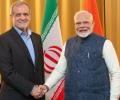
'Within minutes, my mobile began ringing. It was National Security Adviser Brajesh Mishra, asking why the Iranians were complaining.' 'I explained that we had only restated our position in the light of the conclusion reached by the IAEA, but will remain helpful to Iran to reach a consensus.' 'Then came a call from Foreign Secretary Kamal Sibal, repeating what Mishra said about the Iranian complaint.' 'I was very impressed that Iran was able to reach two top officials in India to intervene at short notice,' recalls Ambassador T P Sreenivasan.

'What the Americans want is to destabilise Iran. For destabilising Iran, you need access. 'One access is through Iraq. The other access is through Pakistan.'

'...it should not delude itself into thinking that India's security or its great-power ambitions will be advanced by those partnerships.'
'Instead, what India should focus on is on riding out the next three-and-a-half years of Trump's presidency with minimal damage to itself.'
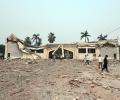
'Every decision India makes along the LoC, it must also consider implications along the LAC.'
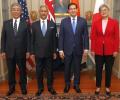
The Quad grouping has called for bringing the perpetrators, organisers and financiers of the Pahalgam terror attack to justice without any delay and urged UN member nations to extend cooperation for it.
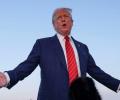
United States President Donald Trump on Tuesday said India has not been a good trading partner and announced that he will raise the tariffs on New Delhi 'very substantially' over the next 24 hours because it is buying Russian oil.

'Pakistan has found itself in a favourable position after Operation Sindoor by appreciating the mediation as claimed by Trump and recommending him for the Nobel Peace Prize.'
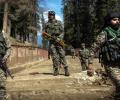
'If there is a military standoff eyeball to eyeball on the western border, the Chinese could create problems by making movements in the north, in our northeast, which could involve us tying down some forces there so that could stretch our military actions.'

The formulations in the declaration in reference to terrorism is going to be to our "satisfaction", Dammu Ravi, secretary (economic relations) in the external affairs ministry said on Monday.

The crises of the 21st century, 9/11, the economic meltdown, COVID-19, Russia-Iran war and the Hamas-Israel war seem to be never ending. In this situation, Iran might be contemplating a nuclear deterrent to defend itself, observes Ambassador T P Sreenivasan, the distinguished long-time Rediff contributor who turns 80 on June 17..

'Fears in Washington began to intensify when it was realised that subsequent Pakistani and Indian attacks on major military facilities -- which were significant in terms of geographic scope and intensity -- could rapidly take both sides to where neither actually wanted to go.' 'The US objective was to stop the fighting as soon as possible. Everything else was secondary.'

India and the US signed a historic agreement to cooperate in civil nuclear energy sector in October 2008.

Although the credit for acquiring the technological skill must be given to India's outstanding nuclear scientists, the decision to go nuclear was a political one that entailed clarity of vision, courage and resolve, points out Rup Narayan Das.

Trump couldn't care less anymore about the Israeli demand for Iran's 'de-nuclearisation' and 'de-militarisation.' Trump pins hopes on a grand bargain with Iran as a partner in America First, argues Ambassador M K Bhadrakumar.

Reports (not denied by India) that the USA had 'for the first time provided real-time details to their Indian counterparts on the Chinese positions and force strength in advance of a PLA incursion' into Tawang at the LAC in December 2022, helping India thwart China's expansionist designs, show how operationally effective the USA-India friendship has become on the ground. A engaging excerpt from Sreeram Chaulia's must-read new book, Friends: India's Closest Strategic Partners.

The BRICS nations condemned the Pahalgam terror attack, advocated for a zero-tolerance approach to terrorism, and criticized rising tariffs during their summit in Rio de Janeiro. They also addressed global challenges and called for reforms in international institutions.

'We are too important to want to be paired with Pakistan but too intensely connected to it to successfully detach ourselves,' asserts Aakar Patel.

Despite the nuclear crisis in Japan, Prime Minister Dr Manmohan Singh on Saturday night batted for nuclear power as an essential option of energy and said the present "nervousness" in the world would end when the issue is discussed in a "cool-headed" manner.

After the 1962 War with China, there was a demand to forge greater defence cooperation between India and the West. One such voice was that of Sudhir Ghosh, a distinguished MP, to tie up strategic cooperation with the USA immediately after the Chinese attack on India, recalls Rup Narayan Das.
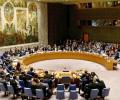
The United Nations Security Council held closed-door consultations on rising tensions between India and Pakistan, with envoys calling for restraint and dialogue. The consultations, requested by Pakistan, lasted for about an hour and a half. UN Secretary-General Antonio Guterres expressed concern over the tensions, urging both countries to avoid a military confrontation. India's former Permanent Representative to the UN, Syed Akbaruddin, said that no consequential outcome could be expected from the discussion.
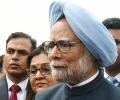
Condolences have poured in from across the globe, including from the United States, Canada and Sri Lanka following the demise of former Prime Minister Manmohan Singh.

As India's stock rises, the resolution of the border row may become even more difficult, warn Harsh V Pant and Kalpit Mankikar.

As a leader, he was ambitious, not for himself but for India and its people. His was not the short-term election cycle calculation of individual political gain. His was a practical vision of how to better the lives of his fellow citizens, asserts Ambassador Shivshankar Menon, who served as foreign secretary and national security advisor when Dr Singh was prime minister.
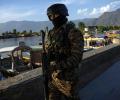
The 'mediation' by the United States from behind the scene on the diplomatic track appears to be once again working, which calls on both Delhi and Islamabad to show restraint and pull back from a military confrontation, notes Ambassador M K Bhadrakumar.
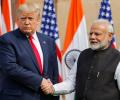
The China threat continues to resonate in the strategic partnership between India and the USA, points out Rup Narayan Das.

In a year bookended by intractable conflicts and geopolitical fragmentation, India focused on ramping up military prowess by broadly firming up defence procurement worth Rs 4.22 lakh crore even as Indian and Chinese militaries completed pulling back their troops from border face-off points in eastern Ladakh.

The two countries also signed three other agreements -- to enhance aviation links, to jointly work in the area of energy efficiency and promotion of parliamentary cooperation.

It's time India re-visited its Western alliances for the attitude and approach that the West reserves for the nation when it comes to security cooperation of the kind that they might not have visualised outside of China, India's bug-bear, asserts N Sathiya Moorthy.
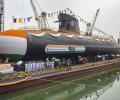
The status of the current submarine force level is alarming and we need to address the threat perceptions expeditiously. Critical decisions pertaining to national security cannot be delayed any further due to the rapidly changing maritime threat perceptions and growing strategic importance of the Indian Ocean region, asserts Commodore Venugopal Menon (retd).
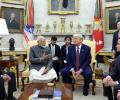
'By his words, actions, and body language during their joint press appearance wanted to convey his personal respect and, more broadly, his desire to work closely with India.'

Talking about the threat of terrorism, he said "As diverse and pluralistic societies, we both face threats from fundamentalist terrorism. Yet, we do not seem to be able to cooperate as effectively we should in some critical international forums dealing with this subject."

The Saudi-Pakistan nuclear weapons cooperation is meant to sound alarm bells in Washington, reminding the Obama administration that its overtures to Iran would have serious negative consequences in terms of its ties with its closest allies in the region, says Ambassador Talmiz Ahmad. Exclusive to Rediff.com

Rhodes remarks on India came in response to a question about why some countries like China are opposing India's membership in the 48-member NSG.
"We are considering setting up of a nuclear security Centre of Excellence in China through cooperation with relevant countries in order to play a bigger role in regional nuclear security cooperation," Hu said in his remarks at the Nuclear Security Summit.
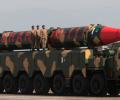
Asserting that Pakistan developing sophisticated missile technology will give it the capability to strike targets well beyond South Asia, including in the United States, a top White House official said on Thursday that the Asian country's actions are an emerging threat to the United States.
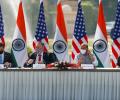
Henry Kissinger once said, 'It may be dangerous to be America's enemy, but to be America's friend is fatal.' India will have to wait and see, observes Rajeev Srinivasan.

Any miscalculation and miscommunication are fraught with the risk of a major catastrophe, warns Rup Narayan Das.
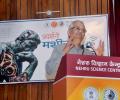
'Why should we disclose classified information to satisfy those who doubt our Hydrogen Bomb capability?'
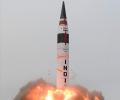
Maintaining that its strategic capabilities were not targeted against any particular country, India has said that it abides by all applicable international obligations and expects others do the same, while responding to Chinese reaction to its test-firing of Agni V missile.
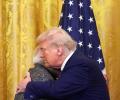
'He needs to see results while he is in office.'
 © 2026 Rediff.com - Advertise with us - Disclaimer - Privacy Policy - Sitemap - Feedback - About us - Terms of use - Grievances